Presenting With AI: What Elementary Students Taught Me About the Future of Work
Last week, I did something that I didn’t expect to enjoy as much as I did.
I co-presented with AI.
More specifically, I co-presented with Gemini, using an iPad and the Gemini app, during an elementary school Careers Day event. Whole classes rotated through, and I had about a half hour with each group. My goal wasn’t to “teach AI,” exactly. It was to help students start developing the kinds of human skills they’ll need in a future where AI tools aren’t a novelty, but a daily co-worker.
And what happened during those sessions shifted something in me. Because once you’ve presented with AI, you can’t unsee what’s coming next.
The Real Focus Wasn’t AI… It Was the Human Skills Behind It
When people hear “AI in schools,” they often assume the conversation is about tools. But the tools are the easy part. The real work is building the human capacity to use those tools well.
This is actually something we’ve been very intentional about in our district. We use the skills outlined in the latest World Economic Forum report as one of our key drivers for identifying what students need to learn to be successful in future careers—especially careers we can’t even define yet. The future of post-secondary education feels uncertain. The way people learn and prepare for careers feels uncertain. But the skills highlighted by the WEF are the kind of skills we can all agree are worth developing in classrooms with confidence.
So instead of focusing on Gemini as the star of the show, I built the session around the skills students will need to become functional, productive humans in an AI-supported world. Skills like communicating with clarity and purpose, using strong vocabulary, thinking critically, planning before acting, and understanding when to delegate tasks to technology versus when to do the thinking themselves.
I also wanted them to see that creativity and reflection are not “extras.” They’re essential. If AI can do the basic tasks faster, then the human advantage becomes our ability to think in diverse, meaningful, and original ways.
Obviously, I didn’t present these as a formal bullet list to third graders. But these themes were embedded in everything we did.
The Setup: Gemini as Our Onboard Ship Computer
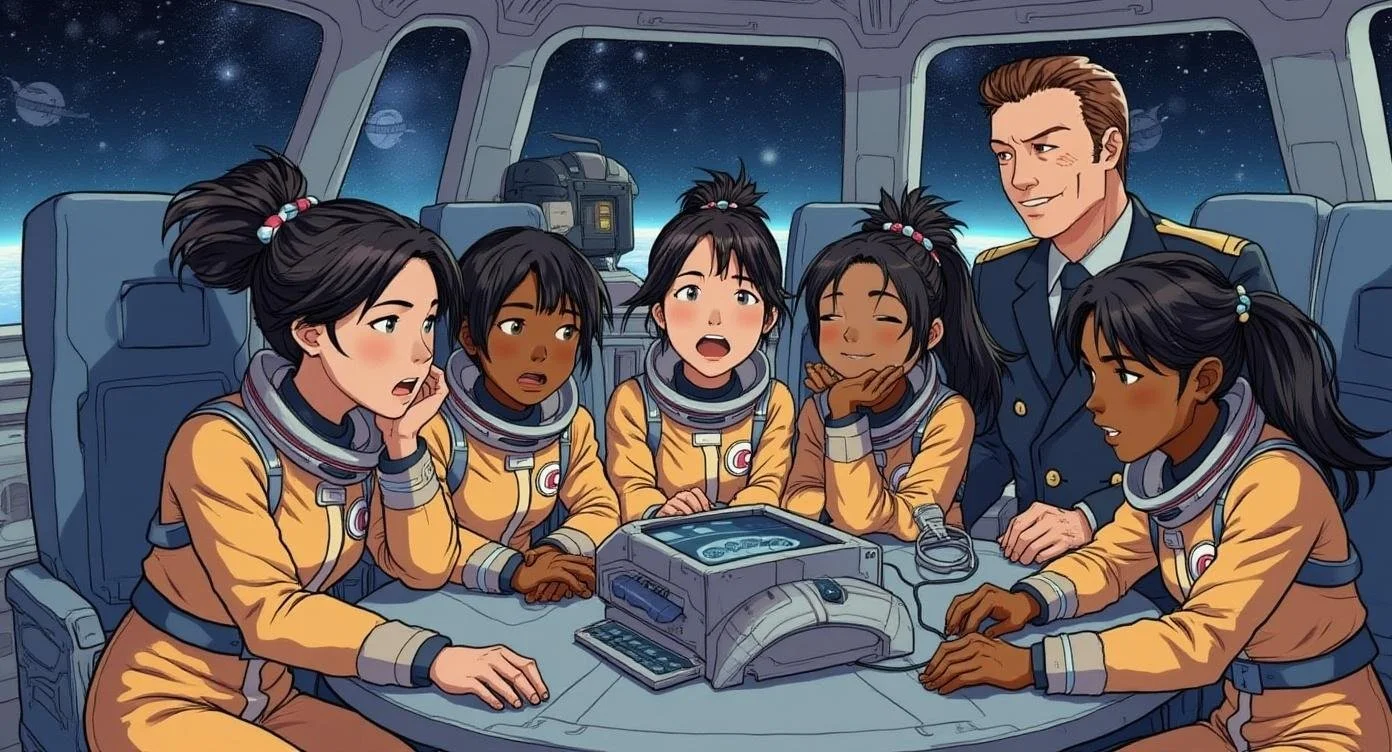
To make the experience engaging and memorable, I built a simple narrative. I pre-crafted a prompt for Gemini ahead of time and gave it a role: Gemini was our onboard ship computer, helping us navigate our spacecraft on a journey to a galaxy far away.
Its job was to hold me accountable to clear and concise communication, serve as a “tour guide” to the stars, and act as a co-teacher by helping students understand how to interact with AI effectively.
In other words, Gemini wasn’t just answering questions. It was part of the experience. And it worked.
A Powerful First Step: Asking Permission to Be Imperfect
Before we even started, I asked the students for something important. I asked their permission for this to not go perfectly. I told them we were trying something new, and that experimentation sometimes comes with glitches, awkward moments, and learning as we go.
That wasn’t just a throwaway comment. It was modeling.
Because if we want teachers and students to take risks with new tools, we have to normalize what it looks like to be a beginner again. I quietly hoped the adults in the room heard it too.
Gemini Was Great… Until It Wasn’t (And That Was the Lesson)
Gemini performed really well overall. But there were a few slowdowns and glitches, and the kids noticed immediately. Of course they did. They’re sharp, and they don’t miss a thing.
Instead of trying to cover it up or rush past it, we leaned into it. It became an authentic moment to reinforce something I said throughout the session: we are the captains of our ship. The AI is a tool. The human stays in charge.
If the AI gets confused, stalls, or goes off topic, we don’t panic. We redirect. We adjust. We lead. That moment might have been more valuable than anything Gemini said all day.
The Camera Feature Changed Everything
One of the most powerful features of the Gemini app was the ability to turn on the camera—our ship’s “visual sensors.” This turned into an unexpectedly fun and meaningful part of the experience.
Gemini could see the kids. It could see them dancing, moving, waving, and reacting. And suddenly the room felt more alive. The AI wasn’t just a voice answering questions—it was interacting with what was happening in real time.
We even did a little experiment. I held up an image that the students could see, but Gemini couldn’t. The kids described it, and Gemini had to guess what it was. Then, after it guessed, we turned the camera toward the picture so Gemini could “see” it.
The students loved it. And honestly… I did too.
The Moment That Hit Me: I Was Presenting With AI
When I first played with ChatGPT, I never imagined a moment like this. But now that I’ve experienced it, I can’t unsee it. It was genuinely surreal—in the best way. I wasn’t presenting about AI. I was presenting with AI.
Gemini would take over after I asked a question, and while it spoke, I could walk around the room, observe students, interact, and read the energy of the class. It felt like having a co-presenter—except I had full control. And unlike a human co-presenter, I could cut Gemini off mid-sentence and take the floor back instantly.
That alone was a strange new kind of power. It made me realize that AI isn’t just changing what we teach. It’s changing what it means to present, facilitate, and lead learning.
What the Kids Revealed About AI Use Was Eye-Opening
I asked a simple question during the session: “Who here knows what AI is?” Every single student raised their hand.
Then I asked: “Who here has used AI before?” Every single hand stayed up.
100%.
Now, I’m not claiming this is a perfectly scientific sample. It’s possible the environment or context created some bias. But still, the numbers were much higher than many educators want to admit. Kids are not waiting for adults to catch up. They’re already living in the world we’re still debating.
What surprised me even more was how many students casually mentioned that their parents use AI regularly too. Several kids described hearing about it at home, watching parents use it, or even having parents show them what it can do. And this wasn’t just parents in tech jobs or office environments.
One student told me his dad is a professional welder and uses AI regularly to help him figure out how to do parts of his work.
That moment stuck with me. It was a reminder that AI isn’t quietly “on the way.” It’s already embedded in everyday life, and kids are watching it unfold in real time.
They Also Struggled to Explain What AI Actually Is
Even though every student said they knew what AI was, many struggled to describe it clearly. They mixed it up with robots. They described it like it was a person. They assumed it had feelings, a life, a job, a family, a home somewhere.
So we had to talk about it directly. AI isn’t a person. It doesn’t have emotions. It doesn’t “live” anywhere. It doesn’t care if you’re happy or sad. It is a tool—an advanced computer system designed to help humans do work.
And that distinction matters. Because if students don’t understand what AI is, they’ll either fear it, worship it, or trust it too much. None of those outcomes lead to healthy use.
One of the Funniest Moments Was Also One of the Most Telling
At one point, Gemini started talking a little off-topic. So I cut it off. Kind of abruptly. I redirected it and tightened up the conversation.
And the kids lost it. They laughed—an audible guffaw—because they couldn’t believe I was being strict with the AI.
It was funny, but it was also revealing. It showed how quickly kids assign personality and emotional weight to these tools. It reminded me that one of our jobs is to help students learn that they can be respectful, but also firm.
Because again, the human is the captain.
What I’m Taking With Me
This experience gave me confidence. Not just confidence that AI can work in a live setting, but confidence that it can actually improve engagement, improve learning, and create memorable moments that stick. It was useful. It was intriguing. It was fun. And it had impact.
I walked away thinking: If this can work with elementary students, it can absolutely work with adults. So I’ll be doing more presentations like this—more experiments, more co-teaching with AI, and hopefully more moments where students and teachers walk away not just entertained, but better prepared for the world they’re stepping into.
Because the future isn’t coming. It’s already sitting in the classroom.
And now I just hope my onboard ship computer can keep up.