
Removing barriers to MEANINGFUL technology use! 

Educational Tranformation Brian Yearling Educational Tranformation Brian Yearling

Survey Says Freshmen Find Blackboard Resources Helpful

Growing use of Blackboard, the district's Learning Management System (LMS) has sparked conversations about the actual value Blackboard can add to the teaching and learning experience.  Nicole Land, an English Teacher at West High School, has provided some insight on the topic, asking her students how they feel about using Blackboard.

At West High School,  each teacher is maintaining a Blackboard course for each face-to-face course taught.  Within the course the instructors provide students (and their parent(s)/guardian(s)) access to a  course-focused Google Calendar, access to resources and assignments for the course, and possibly even some multimedia content related to the course.    While the implementation is in its earliest stages at West, students are already adapting and responding to the availability of the resources digitally.

Land recently asked 40 of her Grade 9 students enrolled in the West House (a pilot of a traditional "house" structure where teachers co-plan, co-teach, and converse about student progress with a cross-curricular emphasis) how they are using and feeling about the Blackboard course she maintains. There responses add some clarity to the question of how a resource like Blackboard can impact the learning experience for students.

Reviewing the Responses

Question:  What do like about the Blackboard 9 English site?
Points to consider:

  • 40 % said they like the calendar, indicating that these students appreciate clarity about what is planned for and expected of them
  • 38% of the student indicated that they like that they like how the site is organized (25%) or say that it helps them with homework (13% -- orange)
  • Only 5% of the students said "Nothing", although it was an available survey option
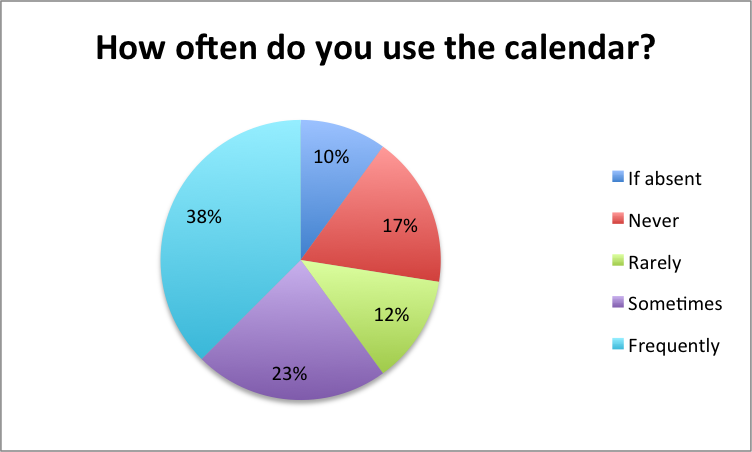
Question:  How often do you use the calendar?
Points to consider:
  • 61% of students said that they use the course calendar "Sometimes" (23%) or "Frequently" (38%) -- an indicator that students are engaging with the course calendar even though it is not required
  • 10% of students report using the calendar if absent, a sign that students take responsibility for missed coursework if required to

Question:  What would you like to see improve (or more of) on the Blackboard 9 English course?
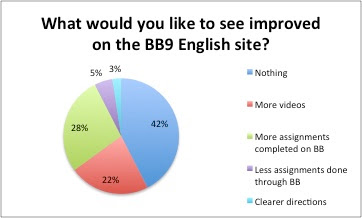
Points to consider:

  • 22% of students asked for more videos to be available -- a possible sign that some students prefer instruction delivered in a "flipped," on-demand model
  • Only 3% of students asked for "Clearer Directions" on the course, suggesting that students have sense of what they are asked to do when engaging with Blackboard content
  • 42% of the students surveyed were seemingly content with the organization of Blackboard, as they suggested nothing needed to be improved at this time
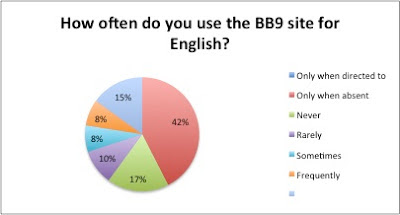
Question:  How often do you use the Blackboard 9 course for English?

Points to consider:

  • The results suggest that students are not presently accessing Blackboard consistently as a critical source for interacting with instructional content
  • The data may speak to the lack of consistently accessible technology for students to access a Blackboard course in as needed in the classroom
While the data collected may not be earth-shaking or surprising, it lends some evidence that students find value in resources that are made available to them in an on-demand, digital outlet such as Blackboard.  With the ever-present societal suggestion looming that young adults today are disengaged and lack educational commitment, embedded within Land's students' responses is an dissenting opinion -- one that suggests making learning resources available to students in alternate ways is accepted and valued by students.
As momentum for Waukesha One, a personalized learning platform being investigated in the School District of Waukesha, grows, teachers, like Land, who are investing significant time and energy into developing their coursework in Blackboard 9 will be rewarded as more students come "online" with more access to resources daily.  Fortunately for Land, by listening to what her students have to say about the experience they are having in the online course today, she'll be in a stronger position to develop an even better online experience for her students in the future.
Read More

Social Research Project - Project from a STEM School

One of our favorite things to do is to demonstrate the real work of our staff and students to provide an outlet for student publishing, but also to serve as a model for reflection related to the skills demonstrated and the learning opportunities presented.

In this post, we have some special guest posters for this blog.  Special thanks to Mikayla P. and Jayden R., 7th grade students for their work and reflection, and to their teacher, Tina K. for providing the opportunity for students.

Project background from the teacher:

This project is called the Facebook Page Design Brief.  Students, paired in groups of two or three, are to choose one of the candidates (president or vice-president) to create a Facebook page for.  The page must encompass who they are. This is a project with specific criteria to follow, and a template formula is provided to jump start research and the project framing properly.

See the Students' Submitted Project:

Student Reflection on the Work (in the students' words):


What did you learn? (Social studies, writing, & 21st century skills)

"We learned about the candidates and their lifestyle around politics. The facts we
found about the different candidates were very intriguing. It was interesting to learn that
they do things just like “normal citizens” do in their life. As writers, we learned how to
combine several facts into organized paragraphs and sections of the project. We looked
at several websites, and learned that one resource is not always the best way to go.
Jayden and I made sure to find the most reliable sources and base our information off of
those. As twenty first century students, we learned to problem solve along the way, and
the first idea doesn’t always work out."

What process did you go through as a learner? (21st century skills)

"We went through many steps through our few days of working on this project. The
first step we went through was collaborating among ourselves to come up with initial
ideas on how to put our page together. The next step in our process was to split the
work load up between the two of us. For example, one person found facts for one
section, and the other found pictures for that part of the project. Next, was to actually
find the information. For some facts and information, we found that as researchers,
we had to dig deeper to find information. Most of it wasn’t just on the first link when
we searched on Google. After we found the facts, we jotted main ideas down in our
notes, instead of long sentences. Next, we had to piece all of the information together
to form paragraphs. Instead of just plopping random facts on the project, we wanted to
make sure the sentences flowed easily and the information was organized. Finally, after
organizing the paragraphs on the page, we revised each part of the project. We wanted
to make sure the project looked neat, and not just random pictures and paragraphs
randomly put on the project."

Should school challenge you in this way?

"Both of us think that school should challenge you to dig deeper when displaying
your information. Instead of just writing down notes and answering questions, we think
school should encourage you to display your knowledge in an interesting, fun way. We
know that when we finish a project, we feel proud about our project, and what we did. It
is a fun way to share what you know. Projects also are more intriguing to the audience
instead of just facts."

Some Final Thoughts to Consider:

At first blush, this project may not present itself as academically equivalent to longer, more complex research and writing tasks students traditionally assigned to students.  However, evaluating the demonstrated skills more carefully, there are some very advanced skill sets, some application of knowledge, and some design principles in place within this sample of work.  Solely in the ability of the students to pare down big ideas into quick, easy-to-understand postings in common language demonstrate that the culminating work reflects deeper research and authentic engagement with the work.  Further, to quote the girls, "School should encourage you to display your knowledge in an interesting, fun way."  The assumption that school work can be fun and that students do take pride when partaking in meaningful (yet challenging) work, is important to acknowledge as we plan our way forward in re-thinking teaching and learning.
Read More
Educational Tranformation Brian Yearling Educational Tranformation Brian Yearling

Reaction to Karl Fisch's "Things I Want My Future Principal to Read"

For those of you who want to get down to business, here is the link:  
As a former English teacher, I've read some pretty deep stuff!  I've had my world turned and my eyes opened to new possibilities a number of times by great literature.  As I've told my former students many times, sometimes you have to wade through some pretty deep stuff to be transformed.  After reading this piece (which will at first feel a little deep and overly philosophical), something in me changed.
The article the link will take you to, written by Karl Fisch, references two works that have shaken him lately.  For me, this piece gave voice to my overwhelming feeling that, with the explosion of technology in the past 15-20 years, we are standing on the glacier of change that is entirely transforming the landscape, serving as the dividing line between what is to come from this point forward and what has come before it.  As Pesce and Turek put it in their article, this dividing line will serve as the marker "before which the ‘dumb’ and disconnected generations of humanity will seem incomprehensible and inhuman."  We are fortunate enough to be standing at that point in time.
If this is true, the question that is begged is clear: "How do you educate people to function, participate, thrive, produce, and succeed in a world that we simply cannot imagine or predict?"
The charge is essential, the answers are varied and highly debatable, but it is SO CLEAR TO ME that there is one suggestion that will NOT suffice -- continue to do what you have always done.
Hopefully the piece, specifically the concepts and images presented in the piece (I just love the image of people being polled about the impact of Gutenberg's printing press and them chuckling to think that anything could have that kind of impact), gives credence to the idea that maintaining a stationary position (specifically in education) during a time of such prodigious change is unethical and unwise.
Just had to share and needed to share with others who might appreciate the thought!


Read More