

Removing barriers to MEANINGFUL technology use!
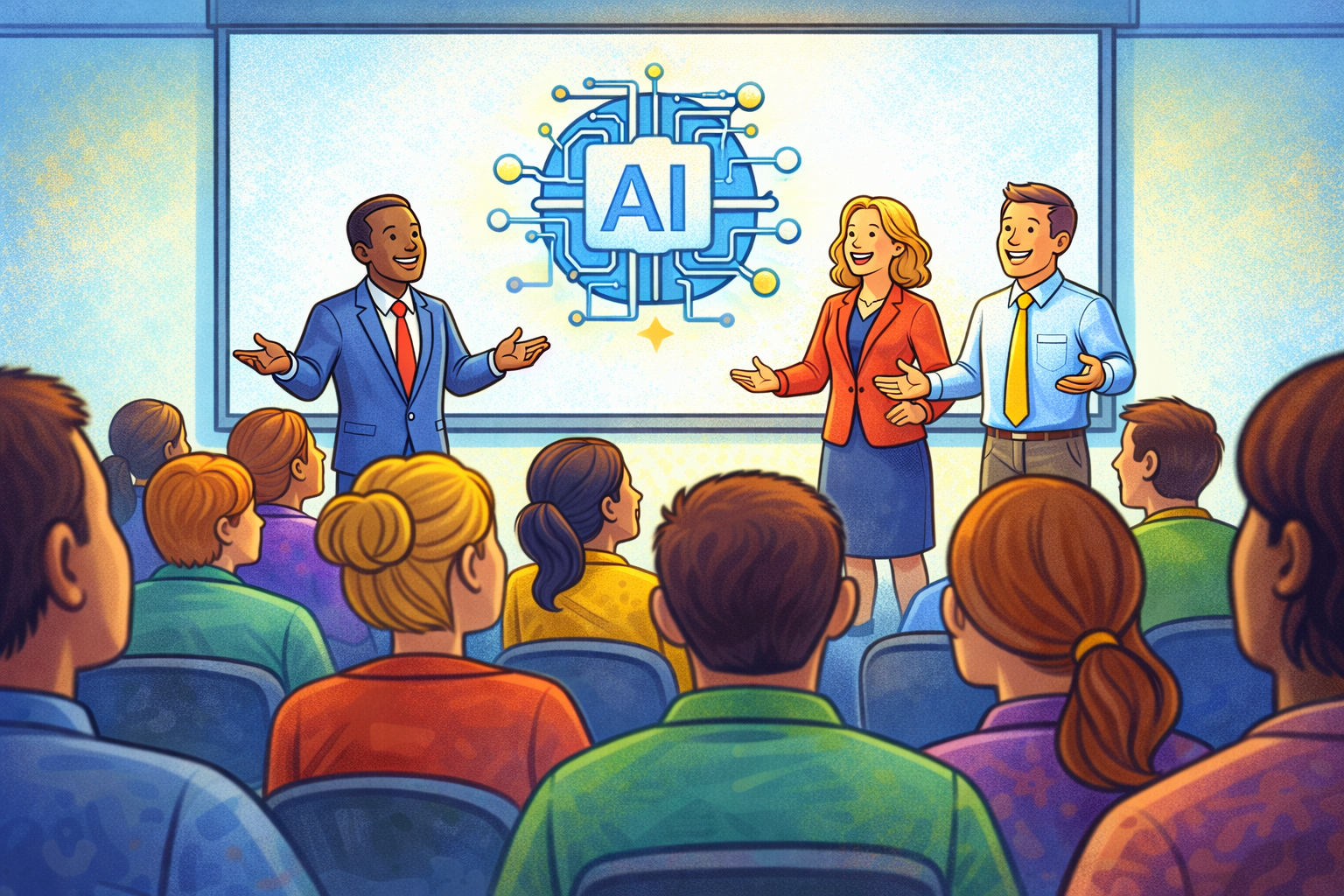
The Leadership Moment AI is Placing on Public Schools
Artificial intelligence will not replace educators, but it will reshape how learning happens. For school leaders, the question is no longer whether AI will influence education, but how intentionally we choose to guide its use in our systems. This post explores practical ways leaders can begin building understanding, rethinking assessment, and moving schools forward.
This week I had the opportunity to spend time with a group of school leaders through The Principals’ Center at the Milwaukee School of Engineering, hosted by Michele Trawicki and the board team who help guide that work. It was one of those sessions that reminded me just how thoughtful and committed our school leaders are — and how much uncertainty they are navigating at the same time.
The focus of our conversation was artificial intelligence and what it means for schools right now. Not in the abstract sense of “what might happen someday,” but in the very practical sense of how leaders can begin helping their systems understand and respond to these tools today. The presentation is available here.
One of the central ideas we explored was this: educators will not be replaced by AI. But organizations that learn to use AI effectively will absolutely move faster than those that do not.
That distinction matters.

For many years, schools have been able to treat new technologies as optional innovations that a few curious teachers explore first. Eventually practices spread, systems adapt, and the change finds its way into classrooms more broadly. AI feels different. It is not simply another digital tool layered onto existing practice; it is a technology that has the potential to reshape how knowledge is created, how work is done, and how learning is personalized.
As a result, the response cannot live only in a few innovative classrooms. It has to involve leadership.
Where Leaders Can Begin Right Now
Much of our time together focused on practical places leaders can begin. In some cases that starts with something as simple as building understanding. Many educators are hearing about large language models, generative AI, and AI assistants without ever having a clear explanation of what these systems actually are or how they work. Helping staff develop that foundational understanding is one of the most important leadership moves available right now.
From there, the conversation quickly turns to teaching and learning. If AI tools can assist with drafting, summarizing, brainstorming, and problem solving, what does that mean for the way we design learning experiences? How might assessment strategies need to shift when students have access to tools that can generate text or help solve complex problems? These are not questions teachers should be left to navigate alone. They require thoughtful discussion across teams, departments, and leadership groups so that schools move forward with clarity rather than confusion.
This was the heart of the conversation with the Principals’ Center: not predicting the future, but identifying the leadership actions that can begin today.
At the same time, we also acknowledged something happening just beyond the edges of public education. Around the country, new learning models are beginning to emerge that use AI as a core part of how instruction is delivered and personalized. One example we briefly discussed was the model promoted by 2 Hour Learning, which suggests that AI-driven tutoring systems could allow students to complete academic learning much more efficiently while freeing large portions of the day for other pursuits.
Whether those models ultimately succeed or not is almost beside the point. What matters is that they are being built, marketed, and offered as alternatives to traditional schooling.
Let’s be clear: families are paying attention.
Why This Moment Calls for Leadership
Public education operates within a system where enrollment matters. Buildings, transportation, staffing, and programming all depend on funding structures tied to the number of students we serve. If new models begin attracting even small numbers of students away from traditional systems, the ripple effects eventually become real for districts and communities.
This is not a doomsday prediction. But it is a reminder that the landscape around us is changing faster than it has in a long time.
For decades, schools have been asked to evolve while simultaneously maintaining stability. We have worked to improve outcomes, support students, and meet growing expectations while largely operating within structures that have remained familiar for generations. Artificial intelligence introduces a moment where that balance may need to shift. The tools now available create opportunities to rethink how learning is personalized, how feedback is delivered, and how educators spend their time.
None of that diminishes the human work at the center of education. If anything, it amplifies its importance. Students will always need adults who mentor them, challenge them, guide them, and help them develop the judgment and character required to navigate a complex world. But the systems surrounding that work must evolve.
The goal of conversations like the one we had at the Principals’ Center is not to create urgency for its own sake. It is to encourage thoughtful leadership. If districts have not yet begun exploring how AI fits into their systems, it is not too late. But we are approaching a moment where waiting much longer means allowing others to define the future of learning without us.
Schools have an opportunity right now to shape how these tools are used, how they support teaching and learning, and how they strengthen rather than weaken the mission of public education.
That work begins with leaders who are willing to learn alongside their staff, ask difficult questions about existing practices, and take the first deliberate steps forward.
The future of education will not be built by AI.
But it will almost certainly be shaped by the leaders who decide how — and whether — to use it.

The Most Important AI Tool We Gave Teachers Was Time
We had just 90 minutes with each content area team, but once teachers were given a little clarity, a few examples, and time to explore, the conversation shifted from fear to possibility. The most important AI tool we gave them wasn’t Gemini or a prompt template—it was time to imagine what real student learning could look like.
This week, our secondary educators participated in an in-person professional learning day designed to support the curricular work already underway across our district. Each content team was spending the day engaged in essential standards work—clarifying what matters most for student learning.
And that was the key.
When we carved out a 90-minute window for AI professional learning, we were intentional about not treating AI as the “new shiny thing” to bolt onto instruction. Instead, we rooted our work in the same anchor as everything else happening that day: standards, learning targets, and student outcomes. Because this isn’t about tools. It’s about what teachers can build when we give them space to think.
We didn’t have much time — but we made it count
We met once with each content area. Ninety minutes. In person. Fast-paced. We covered the essentials: prompt building, AI literacy, and how large language models work in plain language. We talked about the fact that these tools are prediction machines, not truth machines—and that they will confidently produce false information. We also addressed policy. We wanted clarity around what was allowed, what wasn’t, and what responsible use actually looks like in the classroom.
But the most important part of our sessions wasn’t the information we delivered. It was the time we protected. We carved out space for teachers to imagine the tools in their environment, with their students, teaching the content they love. We gave examples. We modeled. We left them with a recipe. Then we got out of the way.
Teachers didn’t need convincing — they needed permission

Before the day began, we knew one word would show up early and often: cheating. It’s one of the most persistent concerns educators have raised in recent months. And it’s a valid one. Teachers care deeply about authentic student work.
So we addressed it head-on. We talked clearly about the reality: our policy does not support AI being used for cheating, and teachers have every right to define when AI is not appropriate. But we also made something else clear: AI cannot be treated as a tool that is never allowed as a standing rule.
And something fascinating happened. Once teachers had clarity—once they had permission, clear answers, and an opportunity to see the tool used differently—the word cheating disappeared. In every session. The tone shifted from fear to curiosity.
What teachers did with time
Teachers didn’t need more slides (don’t worry — we had that part, too, for the mini-lesson). They needed a window to think, create, and collaborate. And the moment we gave them that window, they did what teachers always do: they started building.
Snapshot #1: “Wait… I could have students critique the AI.”
At one point, a teacher pulled me aside during work time and said:
“Oh my gosh. I could have my students critiquing the work the AI did. I had never thought of that.”
That moment mattered because it represented a shift away from seeing AI as an answer machine—and toward seeing it as a thinking partner. Critiquing AI output isn’t a shortcut. It’s analysis. It’s evaluation. It’s exactly the kind of cognitive work we want students doing more often.
There were other moments like this. Moments when teachers realized they did not have to do the work of translating every document for students if they taught students how to have the tools translate the document for them. They didn’t have to curate every resource into a NotebookLM and then share it with the students if they taught students how to create their own NotebookLM with the resources already provided.
And that has an impact on students as well. The idea that you have to put in the work, learn the tools, and be responsible for creating your own learning opportunities is something that will serve all students well in the future. The maid and butler of their learning environments has been let go. They have to learn how to survive and succeed, to do for themselves, and to make the most out of the tools and opportunities they are given. That will have a positive impact on student learning.
Snapshot #2: A team built a project-planning AI tool in real time
In another room, a group of teachers focused on a familiar student challenge: students often begin project-based learning without a plan, and productivity suffers quickly. So they built one. In our 7 minutes of work time on that tool, they literally had a working prototype. The powers of AI technology were in full display.
Using Gemini, they designed a project-planning “Gem” that could guide students through building a plan, organizing resources, identifying deadlines, and staying focused. In less than 90 minutes, teachers went from “What even is a Gem?” to creating something that could immediately support students.
Snapshot #3: Reflection feedback that changed student productivity
One teacher shared that he had already been using a Gemini Gem for weekly student reflections in his project-based learning environment. The results weren’t small.
He explained that the immediate feedback students received through the tool had shifted their productivity in a meaningful way. Students weren’t waiting days for feedback—they were getting real-time coaching they could apply immediately.
Not only was he able to share a success story, but he also grew a network. I noticed two other teachers meander over during work time to see his reflection gem in action. They weren’t from his school. They didn’t know the work he had been doing. And in about 8 minutes of work time, they made a connection and he felt seen for the idea he put into the room.
Bonus snapshot: A sassy AI conversation with Frida Kahlo
And then there was the moment that reminded us what learning really looks like. A teacher experimenting with Spanish prompts began challenging the AI’s colloquial language, pushing back on phrasing and tone, refining it, and correcting it.
He started imagining students having a conversation in Spanish with AI as Frida Kahlo. At one point, he got a little sassy with the AI, challenging it like a student would. It was funny—and also exactly what we want students to do: engage critically and push beyond surface-level answers. He was also now empowered to improve the AI bot, as he had learned to control it through prompt creation and iterative prompt generation.
The real takeaway: Teachers want to learn
At the end of each session, we were met with gratitude and enthusiasm. Teachers want to make an impact on students every day. They don’t show up to be ineffective. They show up because they care about kids and they care about doing the work well.
What we saw in these sessions was a group of professionals doing what teachers do best: imagining what’s possible. And they did it with a few free tools and a small amount of time.
AI training isn’t the point. Empowerment is.
The biggest success of our professional learning day wasn’t the tools we demonstrated. It was the space we protected. Because the most important AI tool we gave teachers wasn’t Gemini, or prompt structures, or a list of resources. It was time.
Time to think. Time to build. Time to reimagine learning.
And if 90 minutes produced this kind of momentum—imagine what teachers could do with more.